Multimodal Discourse Analysis and Audience Engagement of Meme-Based English Teaching on Instagram @kotesu_8
A study of how an Indonesian Instagram account teaches English with memes, and how 88,000+ followers actually respond in the comments.
@kotesu_8 is an Indonesian account that teaches English grammar using meme images, bilingual text, and cat mascots. Its top three reels alone reached more than 7.3 million views and produced over 2,150 comments.
This thesis takes those three reels and asks two questions: how is the lesson built on screen, and how does the audience respond to it? The first question is answered with Kress & van Leeuwen's visual grammar. The second is answered by thematically analyzing every comment with Braun & Clarke's six phases.
The researcher is also the creator of the account — this is practitioner research, disclosed openly and managed with reflexive safeguards.
Meme-based English teaching on Instagram is a participatory event. The lesson does not end on the screen — it is continued and reshaped by the audience in the comment section.
- Background — why English on Instagram, who @kotesu_8 is, the research gap.
- Literature & Theory — the two frameworks used: visual grammar & thematic analysis.
- Method — which reels, how comments were filtered to 2,154 text-only top-level comments.
- Findings — how the reels are built, plus the recurring & unique comment themes (humor leads in every reel).
- Conclusion — the participatory-event argument and three contributions.
- Appendix — full thesis PDF, references, reel scripts, every slide screenshot, live comments search, and Instagram embeds.
Five parts in about fifteen minutes.
Background & Research Problems
- Social media as informal learning · EFL in Indonesia
- Meme-based English teaching · @kotesu_8
- Practitioner-research disclosure
- Two research problems
Indonesian students learn English in school, but a lot of them say they only really understand it when they bump into it on Instagram. This chapter sets the stage: why social media has become a learning space, who @kotesu_8 is, what previous researchers have already tried, and where they stopped — the gap this thesis fills.
English learning has moved from classrooms to feeds.
@kotesu_8 · meme-based English teaching for Indonesian audiences.

Combines PowerPoint slides, recurring cat mascots (Bakekok in Reel 1; printed ABCD cat in Reels 2 & 3), internet memes, and bilingual Indonesian–English text to teach grammar through humor.
No prior study combines all five elements.
| Study | K&vL | IG | Memes | EFL | Cmt. |
|---|---|---|---|---|---|
| Indrayani (2018) · G-Dragon images | ✓ | ✓ | — | — | — |
| Tirtajaya (2023) · Webcomics | ✓ | — | — | ✓ | — |
| Aslan (2024) · Turkish micro-celebs | ✓ | ✓ | — | ✓ | — |
| Domínguez & Bobkina (2021) · classroom memes | ✓ | — | ✓ | ✓ | — |
| Hakököngäs et al. (2020) · far-right memes | ✓ | — | ✓ | — | — |
| Alshreef & Khadawardi (2023) · TikTok vocab | — | — | — | ✓ | — |
| This study (2026) · @kotesu_8 | ✓ | ✓ | ✓ | ✓ | ✓ |
Research Problems & Aims of the Study
1.2 Problems
How are visual and linguistic elements composed to construct English language lessons in the meme-based Instagram reels of @kotesu_8?
How do followers engage with and respond to the meme-based English teaching content, as reflected in the comment sections?
1.3 Aims
To analyze how visual and linguistic elements are composed to construct English language lessons.
To explore how followers engage with and respond to the content as reflected in the comment sections.
Literature & Theoretical Framework
- Six prior studies · the literature gap
- Kress & van Leeuwen · Visual Grammar (2006)
- Braun & Clarke · Thematic Analysis (2006)
- Progressive reveal added as a temporal dimension
Two frameworks ground the analysis. To read each reel as a visual text, the thesis uses Kress & van Leeuwen's visual grammar — three metafunctions for asking what an image shows, how it relates to its viewer, and how its parts are arranged. To read the comment sections, it uses Braun & Clarke's thematic analysis — six explicit phases for moving from raw text to named themes. Because Instagram reels unfold in time, the thesis adds progressive reveal as a fourth, temporal dimension.
Three metafunctions · plus progressive reveal as a temporal addition.
- Narrative — vectors / actions
- Conceptual — classification, analytical
- Contact — demand vs offer gaze
- Social distance · attitude · modality
- Given–New · Ideal–Real
- Salience · framing
Six phases applied to 2,154 comments.
- 01FamiliarizationRead and re-read each reel's comment dataset to become familiar with patterns, tone, and recurring expressions.
- 02Initial codingIdentify interesting features — quiz answers, school comparisons, jokes, questions — and code each comment systematically.
- 03Searching for themesGroup related codes into candidate themes capturing larger patterns of engagement.
- 04Reviewing themesCheck candidate themes against coded extracts and the dataset as a whole.
- 05Defining & namingWrite a clear definition and a short evocative name for each theme.
- 06Producing the reportWrite up with representative quotations and frequency tables.
Research Method
- Qualitative · following Creswell
- Two data types · three top-viewed reels
- Inclusion / exclusion criteria → 2,154 comments
- Positionality safeguards · research ethics
This is a qualitative study — the goal is to describe and interpret how meaning is built and how it is received, not to measure variables. The three reels were picked because they had the highest view counts. Their comment sections were exported via Dolphinradar.com, then filtered with explicit rules so that anyone repeating this study can rebuild the exact same dataset of 2,154 comments.
Three top-viewed reels and their comment sections.

2,154 text-only comments after filtering.
- • Top-level comments (replies excluded)
- • At least one alphabetic word (ID or EN)
- • Posted on/before the export date
- • Emoji-only or @-mention-only
- • Spam / promotional
- • Researcher-authored (creator)
- • < 3 alphabetic characters
Final dataset
Comment sections exported via Dolphinradar.com in January 2026.
Specific steps to make the analysis traceable.
Positionality safeguards
- Themes derived inductively from comment data alone, before integration with multimodal findings.
- Open list of non-fitting comments kept throughout — framework not closed prematurely.
- Excluded comments by myself and by close associates of the account.
Research ethics
- All usernames anonymized (@user1, @user2…) — mapping not published.
- Public figures named in critical contexts were lightly paraphrased.
- No private messages or non-public data used. No comment by minors knowingly included.
Findings & Discussion
- Problem 1 · Multimodal composition — three metafunctions + progressive reveal
- Problem 2 · Audience engagement — humor leads in every reel · 4 unique themes
- Tables 3.1 · 3.2 · 3.3 with representative voices
Two questions, two answers. The first half asks how each reel constructs its lesson on screen — using classification, demand gazes, a left-Indonesian / right-English layout, a stable red-and-green color code, and progressive reveal. The second half asks what 2,154 followers actually wrote in the comments: a stable cluster of recurring themes appears in every reel — led, in all three, by humor and meme reactions — while Reels 2 and 3 generate four extra themes uniquely produced by their specific design choices.
Conceptual classification dominates.
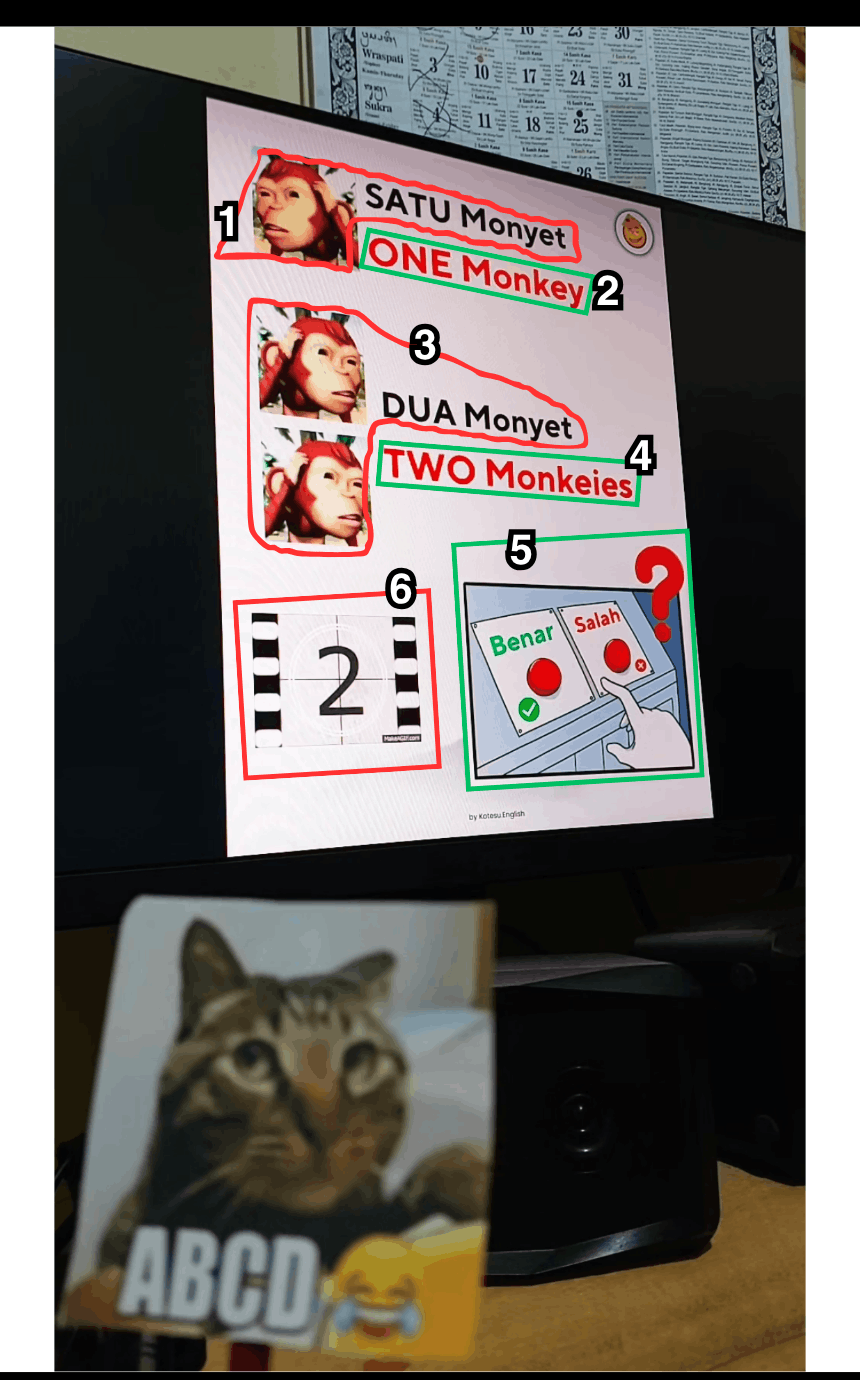
Reel 1 · Slide 1 — singular and plural placed side-by-side as members of the category “plural.” Not doing anything · simply classified.
Bakekok & the ABCD cat turn the viewer into a co-learner.

Reel 2 · The printed ABCD cat takes over the mascot role from Bakekok — demand gaze preserved as a constant.
Given–New, Ideal–Real, and a stable color code.

Reel 1 · Slide 8 — abstract “Plural” at top (Ideal); concrete examples Rats / Cats / Dogs at bottom (Real).
Progressive reveal as temporal multimodal strategy.
The same technique serves a different rhetorical purpose in each reel · together they map a temporal dimension not captured by Kress & van Leeuwen as it stands.
Humor leads in every reel — with a stable cluster behind it.
A core set of recurring themes appears across all three reels: humor & meme reactions, expressing appreciation, comparing to formal school, expressing easy comprehension, and practicing English through own examples. Each reel then adds themes shaped by its own design. The largest theme in every reel is humor — not the quiz prompt — which shows engagement is led by participatory remix rather than by the assigned task.
Themes 1–5 recur in all three reels. Themes 6–7 recur in two of three: Asking Grammar Questions appears in Reels 1 & 3; Answering the Quiz appears in Reels 1 & 2.
Humor and self-made practice lead — above the quiz prompt.
| № | Theme | N | % |
|---|---|---|---|
| 1 | Humor and Meme ReactionsDOMINANT | 245 | 21.8% |
| 2 | Practicing English through Own Examples | 130 | 11.6% |
| 3 | Expressing Appreciation | 98 | 8.7% |
| 4 | Asking Grammar Questions | 74 | 6.6% |
| 5 | Answering the Quiz & Requesting the Reward | 49 | 4.4% |
| 6 | Comparing to Formal School | 41 | 3.7% |
| 7 | Expressing Easy Comprehension | 33 | 2.9% |
| 8 | Other short reactions and tags (uncoded) | 416 | 40.3% |
| Total | 1,032 | 100% |
"Bakekok" · "ngapa ada bakekok disitu" · "[Public figure] is an ape."
— @user22, @user46, @user14 · running mascot joke + political wordplay extend the lesson
"1 jokowi, 2 jokowis" · "Laba: profit. Labalaba: profits." · "There's two puppies that was hangout with me last night…"
— @user71, @user122, @user11 · viewers move from passive watching to active production
"Terima kasih bg, gua follow lu." · "ilmu ni mahall."
— @user28, @user140 · gratitude often paired with a follow
"klo yg ujungnya di kasih ed itu apa sih? kaya passed, studied?"
— @user9 · reel triggers inquiry about adjacent rules
"Trains, planes, cups, buses, dishes, boxes, babies. Mana tiket argo ngawi nya wok."
— @user312 · matches the on-screen order — smaller than humor or self-practice
A metalanguage gap and the trick-question reaction.
| № | Theme | N | % |
|---|---|---|---|
| 1 | Humor and Meme ReactionsDOMINANT | 207 | 33.7% |
| 2 | Expressing Appreciation | 117 | 19.1% |
| 3 | Expressing Easy Comprehension | 78 | 12.7% |
| 4 | Practicing English through Own Examples | 66 | 10.7% |
| 5 | Comparing to Formal School | 45 | 7.3% |
| 6 | Asking About Huruf Mati and Huruf HidupNEW | 35 | 5.7% |
| 7 | Reactions to the Trick QuestionNEW | 31 | 5.0% |
| 8 | Answering the Quiz & Requesting the Reward | 18 | 2.9% |
| 9 | Residual (uncoded) | 17 | 2.8% |
| Total | 614 | 100% |
"ABCD" · "Species [public figure]" · "Tunggal dan jomoknya."
— @user19, @user323, @user187 · new printed cat is tagged just like Bakekok was
"Izin pake pot nya bege, buat ngajarin anak SD." · "Aku senang 500 mb terakhirku di habiskan untuk menonton video ini."
— @user110, @user653 · viewers ask for the PowerPoint to teach with
"Intinya kalo di baca kedengerannya pas itu paling bener." · "Sesuai aturan tidak. Sesuai feeling iya."
— @user378, @user385 · a feeling-based learning strategy emerges
"Bang bedanya huruf mati sama huruf hidup itu ape bang."
— @user164 · unique to Reel 2 · exposes a metalanguage gap
"Pas bener atau salah gw malah jawab true or false."
— @user190 · unique to Reel 2 · auto-translates the prompt
Political memes and the harsh-creator contrast.
| № | Theme | N | % |
|---|---|---|---|
| 1 | Humor & Meme Reactions (Jomok and Wordplay)DOMINANT | 190 | 37.4% |
| 2 | Political Memes and Government CritiqueNEW | 121 | 23.8% |
| 3 | Expressing Appreciation | 69 | 13.6% |
| 4 | Comparing to Formal School | 31 | 6.1% |
| 5 | Contrasting with the Harsh English CreatorNEW | 18 | 3.5% |
| 6 | Expressing Easy Comprehension | 16 | 3.1% |
| 7 | Practicing English through Own Examples | 8 | 1.6% |
| 8 | Asking Grammar Questions | 8 | 1.6% |
| 9 | Uncoded residual | 47 | 9.3% |
| Total | 508 | 100% |
"Anj-ing" · "ngis-ing = pooping" · "Ice cream + ing = bing chilling."
— @user117, @user374, @user278 · the -ing slot absorbs Indonesian slang + global meme vocabulary
"[Public figure] mining in Raja Ampat." · "MBG: national poisoning." · "Plisss bang, aku berdoa untuk keselamatan mu."
— @user140, @user275, @user78 · politician-plus-verb-ing template + audience awareness of risk
"Konten meme + edukasi = peak education." · "akhirnya hp ku berguna juga."
— @user461, @user205 · running 'peak education' compliment
"Guru yang kita semua inginkan tapi tidak kita dapatkan." · "sekarang aku mau daftar di harvard university."
— @user163, @user164 · reel framed as corrective to formal schooling
"Akhirnya kelas ramah untuk pengguna BPJS." · "belajar disini seru, disebelah nangis."
— @user432, @user390 · unique to Reel 3 · frames the gentler tone as a deliberate choice
Conclusion & Contribution
- Synthesis · meme-based teaching as a participatory event
- Three contributions · MDA · digital pedagogy · Indonesian EFL
- Limitations & future research
Pulling everything together: meme-based English teaching on Instagram is not a one-way broadcast. It is a participatory pedagogical event — the creator builds a careful multimodal lesson, and the audience continues, jokes about, criticizes formal schooling through, and politicizes that lesson inside the comment section. This chapter states the answer to each research problem, names three contributions, and acknowledges four limitations.
A participatory event · the lesson does not end on the screen.
The creator builds a multimodal lesson using classification, demand gazes, color coding, and progressive reveal. The audience continues and reshapes the lesson in the comment section · bilingual jokes, follow-up questions, original sentences, political satire, and explicit comparisons to formal schooling.
Where this study adds something.
Limitations & future research.
Four limitations
- Scope · only three reels analyzed — findings cannot be generalized.
- Data type · only text-only comments — emoji & image replies excluded.
- Positionality · insider perspective still shapes which patterns I notice.
- Measure · comments reflect self-reported comprehension, not tested mastery.
Future research
- Analyze a larger corpus of reels and comments.
- Include non-text engagement data (emoji, image replies).
- Compare @kotesu_8 with similar accounts.
- Triangulate with interviews or pre/post tests.
For your time, your attention, and the guidance that has shaped this thesis into its present form.
References & Full Thesis PDF
Twenty-five sources ground this study — click any author on the left to read its PDF inline, or switch to Full Thesis to read the complete 123-page document right here in the page.
Appendix
Everything the analysis was built on, in one place: the full reel scripts, every PowerPoint slide screenshot (click to preview, swipe to navigate), the live comments dataset (fetched directly from Supabase — search & filter all 2,154), and the original reel videos (Instagram embeds or Cloudinary).
The exact words spoken in each slide of every reel video — useful for cross-referencing the multimodal analysis with the audio narration.