Multimodal Artifact
Verb-ing
This analysis uses Kress and van Leeuwen (2006) to identify how visual elements are composed to construct the grammar lesson. The reel focuses on verb-ing through high-modality imagery and consistent layout conventions.
1Representational Meaning
In terms of representational meaning, Verb-ing adopts a primarily conceptual classificatory structure. Unlike narrative structures that involve action and vectors, this reel groups language items into ontological categories (Singular vs Plural).
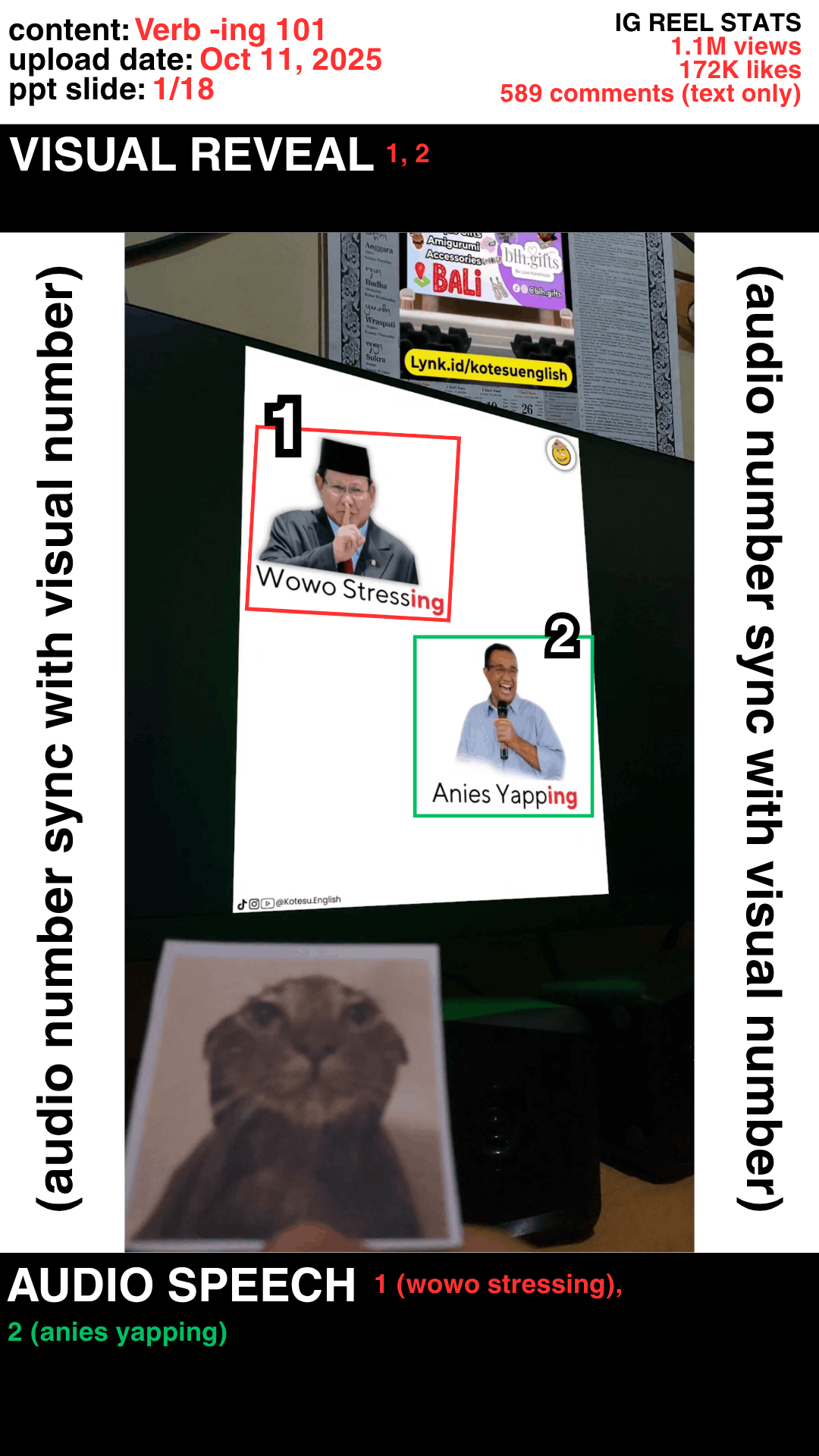
The participants are presented as stable 'members' of the categories being taught. For example, in Slide 1, the categorization is reinforced through visual pairing with the Indonesian substrate.
2Interactive Meaning
The relationship between the represented participants and the viewer is mediated through contact (demand gaze) and modality. Higher modality is used to ground the abstract grammar rules in identifiable, photographic cultural markers.
3Compositional Meaning
Information value is consistently distributed along the horizontal axis, following the Given-New structure. Indonesian text occupies the left (Given) while the target English vocabulary occupies the right (New).
4Progressive Reveal Strategy
The temporal dimension of composition is handled through Progressive Reveal. Elements appear one-by-one, synchronized with the narration to manage cognitive load.